Module · 01
Throughput-driven calibration
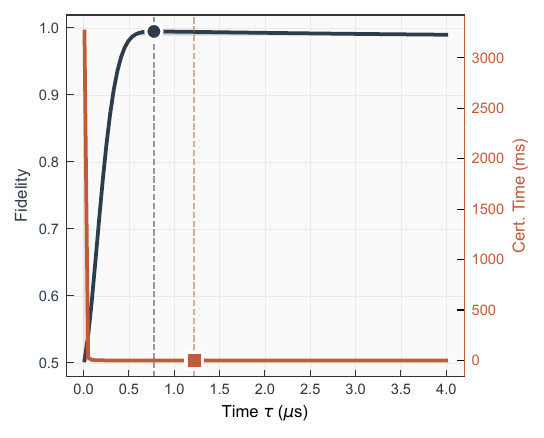
Treats readout as an information channel. Selects integration windows that minimize total certification wall-clock time, accounting for hardware overhead — not just single-shot fidelity.
Superconducting quantum processors spend expensive wall-clock time on measurement, calibration, and certification. ReadoutIQ helps teams choose measurement windows that minimize time-to-confidence across many shots, not just maximize single-shot fidelity. In representative transmon-readout simulations, the wall-clock-aware setting reduces total certification time by about 9–11% without hardware redesign.
Current tool plus roadmap:
minimize time-to-confident-result on a running quantum processor.
Treats readout as an information channel. Selects integration windows that minimize total certification wall-clock time, accounting for hardware overhead — not just single-shot fidelity.
Future modules will evaluate when adaptive measurement strategies are useful in long-readout or high-overhead regimes. Detailed implementation is under development and is not required for the first measurement-window tool.
Quantifies how closely your measurement chain approaches the hypothesis-testing limit. Separates detection-inefficiency and decoherence contributions on a per-system basis.
Deployed as a calibration or firmware update on existing RFSoC-class control systems. No new resonators, no new amplifiers, no requalification.
Technical demo notebooks.
Bring your own χ, κ, T₁, and hardware overhead.
A reproducible notebook that takes your measurement-system parameters and returns the integration window that minimizes wall-clock certification time. Compares against the conventional fidelity-optimal operating point on the same hardware.
Parameters typical of contemporary transmon platforms.
Simulation; on-hardware validation in progress.
Pilots, design partnerships,
and technical conversations.
Send your hardware parameters and we will return a representative speedup estimate within a few days.